What is Asset Tokenization? The Ultimate 2025 Beginner's Guide
Asset tokenization sounds technical, but the concept is simple: converting real-world value into digital tokens on a blockchain. This guide explains everything beginners need to know.
For comprehensive and in-depth coverage, explore our Ultimate Guide to Tokenization and RWA, which covers all aspects of tokenization in detail.
For a comprehensive investment guide, see our How to Invest in Tokenized Assets: Complete 2025 Guide, which covers everything from getting started to building a diversified portfolio.
What is Tokenization?#
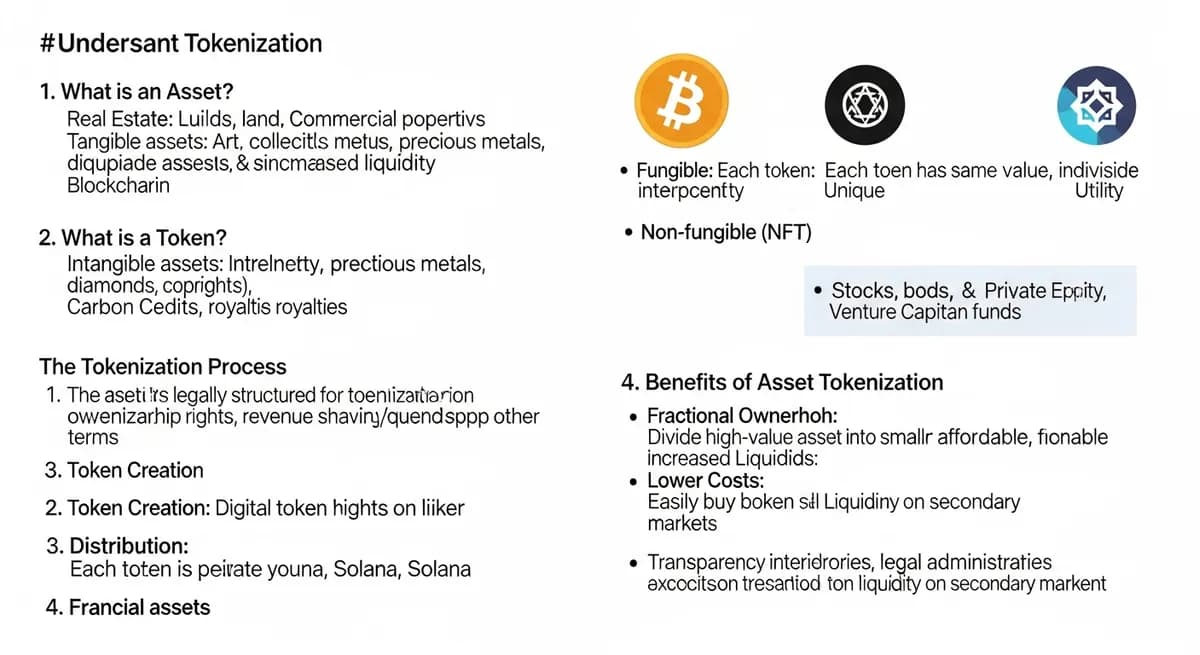
Simple Definition: Breaking a valuable asset into digital pieces (tokens) that represent ownership.
Analogy: Think of a $1 million painting:
- Traditional: One person owns it all
- Tokenized: 1 million tokens @ $1 each - 1 million people can own a piece
Why Tokenize Assets?#
For Asset Owners#
Problem: A $50M office building is locked capital Tokenization Solution:
- Issue 5,000 tokens @ $10K each
- Raise $50M immediately
- Keep building
- Pay token holders rental income
Benefits: Unlock liquidity without selling
For Investors#
Problem: Premium real estate, startups, infrastructure = $1M+ minimums Tokenization Solution:
- Same asset available at $1K-$10K minimums
- Diversify across many assets
- 24/7 trading (vs market hours)
Benefits: Access, diversification, liquidity
How Tokenization Works: Step-by-Step#
Step 1: Choose Your Asset#
- Real estate, equipment, commodities
- Securities, infrastructure, art
- Must have clear value
For guidance on selecting assets, see our Choosing Assets to Tokenize: Decision Framework.
Step 2: Legal Structure#
- Create Special Purpose Vehicle (SPV)
- Register as financial instrument
- Get regulatory approval
Understanding regulatory requirements is crucial. See our Tokenization Licensing Requirements by Jurisdiction 2025 for global compliance guidance.
Step 3: Valuation#
- Professional appraisal
- Determine total value
- Set token price
Step 4: Token Design#
- Decide token supply (e.g., 5,000 tokens)
- Define rights (ownership %, voting, dividends)
- Smart contract programming
Learn about token standards in our ERC-3643 vs ERC-1400 Security Tokens comparison guide.
Step 5: Smart Contracts#
- Deploy blockchain token
- Program compliance rules
- Link to legal documents
Security is paramount. Review our Smart Contract Security Audit Checklist before deployment.
Step 6: Custody & Operations#
- Professional custodian holds asset
- Distribute income to token holders
- Handle transfers/trading
Step 7: Investor Sales#
- Market to qualified investors
- Collect funds
- Distribute tokens
For investors, see our comprehensive How to Invest in Tokenized Assets: Complete 2025 Guide for the complete investment framework.
Real Example: Office Building Tokenization#
The Asset: $10M office building in London
Tokenization Process:
- Create SPV to hold building
- Get FCA approval (UK regulator)
- Professional valuation: $10M confirmed
- Design: 10,000 tokens @ $1,000 each
- Deploy smart contract (ERC-3643 standard)
- Custody: Coinbase holds deed
- Launch: 300 investors buy tokens
- Ongoing: Monthly rental income distributed to token holders
Results:
- Capital raised: $10M
- Investor count: 300 (vs typical 5-10 for traditional)
- Monthly returns: 0.6% (rental income)
- Trading: Investors can sell tokens on secondary market
Types of Assets Being Tokenized#
Real Estate#
- Residential buildings
- Commercial properties
- Agricultural land
- Infrastructure
Why: Unlock capital, fractional ownership
Explore our Real Estate Tokenization: Complete Guide for detailed real estate strategies, or compare REITs vs Tokenized Real Estate to understand the differences.
Commodities#
- Agricultural products (coffee, grain)
- Metals (gold, lithium)
- Energy (oil futures, renewable projects)
Why: Pre-financing, direct buyer connection
Equities & Startups#
- Private company stock
- Venture capital funds
- Employee stock options
Why: Faster fundraising, broader access
Learn about Startup Equity Tokenization: The Future of Fundraising and Employee Stock Options on Blockchain.
Fixed Income#
- Bonds
- Invoice factoring
- Lease receivables
Why: Faster capital deployment, broader investors
See our guides on Private Credit Tokenization and Invoice Financing Tokenization for SMEs.
Infrastructure#
- Power plants
- Transportation networks
- Water systems
Why: Long-term stable returns, major capital
Benefits of Tokenization#
For Asset Owners#
✅ Faster Capital Raise: Weeks vs months ✅ Lower Costs: 40-60% fewer intermediaries ✅ Broader Investor Base: Retail participation ✅ Maintain Control: Keep managing asset
For Investors#
✅ Lower Entry Cost: $1K instead of $100K+ ✅ Diversification: Own pieces of many assets ✅ 24/7 Trading: Secondary market anytime ✅ Transparency: Blockchain records ✅ Passive Income: Dividends/distributions
For Markets#
✅ Efficiency: Reduced settlement time (minutes vs 3 days) ✅ Cost Reduction: 40-60% fewer intermediaries ✅ Access: Brings $500T of assets into 24/7 trading ✅ Innovation: New asset classes tradeable
Risks to Understand#
Investment Risks#
⚠️ Asset Risk: Building loses value = token loses value ⚠️ Liquidity Risk: Tokens may be hard to sell ⚠️ Market Risk: Sector downturn affects value ⚠️ Operational Risk: Company managing asset fails
Technology Risks#
⚠️ Smart Contract Bugs: Code could have errors ⚠️ Blockchain Risk: Platform failure possible ⚠️ Custody Risk: Custodian loses or mismanages assets
Regulatory Risks#
⚠️ Legal Change: New rules could affect token value ⚠️ Jurisdiction: Different countries treat differently ⚠️ Fraud: Unregulated platforms may steal funds
Mitigation#
- Choose platforms with proper licenses
- Review audited smart contracts
- Diversify investments
- Start small, learn over time
Tokenization vs Traditional#
Real Estate Investment#
Traditional:
- Minimum: $500K-$1M
- Time to capital: 6-12 months
- Settlement: 3 days
- Cost: 5-10% fees
- Investors: 5-50 (institutional only)
Tokenized:
- Minimum: $1K-$10K
- Time to capital: 2-4 months
- Settlement: Minutes
- Cost: 1-2% fees
- Investors: 500-5,000 (retail + institutional)
Getting Started as an Investor#
Step 1: Education (Week 1)#
- Read this guide fully
- Review blockchain basics
- Watch 2-3 video explainers
Step 2: Choose a Platform (Week 1-2)#
- Research platforms (see platform comparison)
- Open account
- Complete KYC (identity verification)
Step 3: Start Small (Week 2-3)#
- Invest $1-5K in diversified assets
- Monitor for 1-2 months
- Learn how distributions work
Step 4: Scale Gradually (Month 2+)#
- Invest more as confident
- Diversify across asset types
- Track returns
Common Questions#
Q: Is tokenization legal? A: Yes, in most major markets (UK, Singapore, UAE, etc.). US regulations evolving.
Q: What's the minimum investment? A: Typically $1K-$5K on platforms like Pedex. Some as low as $500.
Q: How often do I get returns? A: Depends on asset. Real estate: monthly. Startups: quarterly or annually.
Q: Can I sell my tokens? A: On most platforms, yes - through secondary market. Liquidity varies.
Q: Is it risky? A: Yes. Asset values fluctuate. Choose established platforms and diversify.
Q: What are fees? A: Platform fees (0.5-2% transaction) + optional custody (0.1-0.5% per year)
Vocabulary Builder#
- Token: Digital representation of ownership
- Smart Contract: Self-executing code on blockchain
- SPV: Special Purpose Vehicle (legal entity holding asset)
- KYC: Know Your Customer (identity verification)
- Secondary Market: Where tokens are traded after initial sale
- Custodian: Entity holding the actual asset securely
- Liquidity: Ease of selling/trading an asset
Learn More: Investing in Tokenized Assets#
Comprehensive Investment Guide:
→ How to Invest in Tokenized Assets: Complete 2025 Guide - Master the complete investment framework
Related Investment Articles:
- How to Start Investing in Tokenized Assets: 2025 Step-by-Step Guide - Getting started guide
- How to Invest in Tokenized Assets: Complete Step-by-Step Guide - Detailed step-by-step
- Tokenized Asset Investment Returns: Real Data from 2024 - Understand returns
- Building a Tokenized Investment Portfolio: Diversification Guide - Portfolio strategies
- Introduction to Asset Tokenization - Basic concepts
Platform & Regulatory:
- Best Tokenization Platforms 2025: Enterprise Comparison Guide - Platform comparison
- Tokenization Regulation, Tax & Compliance: Global 2025 Guide - Regulatory framework
Next Steps:
- Start Investing with Pedex
- Open an Account - Get started today
Ready to Explore Tokenization?#
Ready to Start Investing?
Join thousands of investors building wealth through tokenized assets. Start with as little as $100.
Asset tokenization is transforming finance. Start learning today.