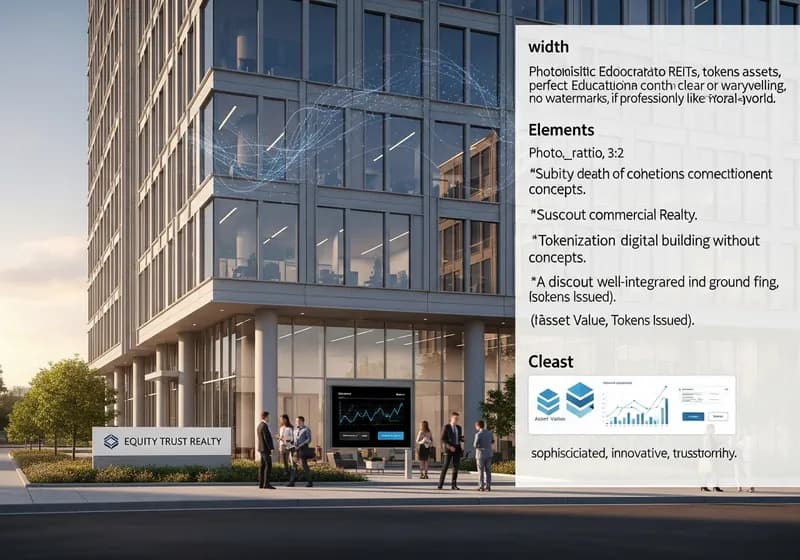


REITs vs Tokenized Real Estate: Which is Better in 2025?
Real estate comparison: This article compares REITs and tokenized real estate. For comprehensive RWA guidance, see Tokenizing Real-World Assets: Real Estate, Supply Chain & Finance in 2025.
Real Estate Investment Trusts (REITs) have dominated real estate investing for decades, but tokenized real estate is challenging this dominance. This comprehensive comparison analyzes both approaches to help investors choose the optimal strategy for 2025.
For comprehensive context on tokenized assets, see our Ultimate Guide to Tokenization and RWA. Learn about real estate tokenization in our Real Estate Tokenization guide, and compare approaches in our RWA vs Traditional Securities guide.
What Are REITs?#
REIT Basics#
Real Estate Investment Trusts are companies that own, operate, or finance income-producing real estate. They trade on major exchanges and must distribute 90% of taxable income to shareholders.
REIT Categories:
Equity REITs (Own and operate properties)
- Residential REITs (apartments, single-family homes)
- Commercial REITs (office, retail)
- Industrial REITs (warehouses, logistics)
- Specialized REITs (data centers, healthcare)
Mortgage REITs (Invest in mortgages)
- Agency backed mortgages
- Non-agency mortgages
- Direct lending
Hybrid REITs (Both equity and debt)
Historical Performance#
Average Annual Returns:
- 10-year average: 8-10%
- Outpaced S&P 500 in some periods
- Dividend yields: 3-4% typical
- Total returns: 6-12% annually
2024 REIT Performance: Mixed
- Residential REITs: +15-20%
- Commercial REITs: -5-10% (office weakness)
- Industrial REITs: +8-12%
- Mortgage REITs: Volatile
What Are Tokenized Real Estate Assets?#
Tokenization Basics#
Tokenized real estate represents fractional ownership in actual properties through blockchain-based digital tokens. Each token represents a proportional ownership stake and claim to rental income.
Key Characteristics:
- Asset-backed: 1:1 backed by physical property
- Fractional: Can own 0.01% of property
- Transparent: Blockchain verification
- Liquid: Tradeable 24/7 (theoretically)
- Direct: Owners hold actual property rights
Current Market#
Market Size: $2.5B (2024), projected $5.8B (2025) Growth Rate: 130%+ year-over-year Primary Markets: US (48%), Europe (32%), Asia (20%) Token Types: Residential, commercial, mixed-use
Detailed Comparison: REITs vs Tokenized Real Estate#
1. Accessibility & Entry Barriers#
| Factor | REITs | Tokenized Real Estate |
|---|---|---|
| Minimum Investment | $100-$500 | $500-$10,000 |
| Accreditation Req | No | Yes (US market) |
| Account Required | Brokerage | Crypto/platform |
| Ease of Buying | Very Easy | Moderate |
| KYC Requirements | Simple | Extensive |
| Winner | REITs |
Analysis:
- REITs: Accessible to any retail investor via standard brokerage
- Tokens: Currently limited to accredited investors in US; more accessible in Europe/GCC
2. Liquidity & Trading#
| Factor | REITs | Tokenized Real Estate |
|---|---|---|
| Trading Hours | Market hours (9:30-16:00) | 24/7 |
| Settlement | T+2 | T+1 to 24 hours |
| Bid-Ask Spread | 0.1-0.5% | 0.5-2% |
| Market Depth | Excellent | Early stage |
| Exit Liquidity | Excellent | Developing |
| Price Discovery | Real-time | Varying |
| Winner | REITs |
Analysis:
- REITs: Years of liquidity infrastructure
- Tokens: Secondary markets developing; illiquidity risk for some offerings
3. Fees & Costs#
| Fee Type | REITs | Tokenized Real Estate |
|---|---|---|
| Brokerage Fee | $0 (most platforms) | - |
| Trading Fee | $0 (most platforms) | $0-1% |
| Management Fee | 0.5-1.2% | 0.8-2% |
| Performance Fee | Rarely | 0-2% |
| Expense Ratio | 0.3-1.2% | 0.8-2% |
| Typical Total | 0.3-1.2% | 1.5-3% |
| Winner | REITs |
Analysis:
- REITs: Lower fees due to scale and competition
- Tokens: Higher fees reflect development stage and customization
Example: $100,000 Investment Over 5 Years
REIT Fees:
Annual fee: 0.7%
Year 1 cost: $700
Total 5-year cost: $3,683
After-fee return (8% before): 7.28%
Tokenized Real Estate Fees:
Annual fee: 2%
Year 1 cost: $2,000
Total 5-year cost: $10,541
After-fee return (8% before): 5.92%
Fee Impact: REITs win by ~1.4% annually
4. Returns & Yield#
| Metric | REITs | Tokenized Real Estate |
|---|---|---|
| Dividend Yield | 3-4% | 4-7% |
| Appreciation | 2-5% | 2-5% |
| Total Return | 5-9% | 6-12% |
| Volatility | Moderate | Low-Moderate |
| Winner | Tie |
Analysis:
- Dividend Yield: Tokens often higher due to direct property exposure
- Appreciation: Similar for both (market dependent)
- Total Return: Tokens potentially higher pre-fees; REITs win post-fees
5. Transparency & Control#
| Factor | REITs | Tokenized Real Estate |
|---|---|---|
| Property Visibility | Portfolio list | Specific properties |
| Financial Data | Quarterly 10-Qs | Monthly reports |
| Asset Composition | Holdings disclosed | Full documentation |
| Voting Rights | Limited | Often substantial |
| Control Level | Minimal | Moderate-High |
| Winner | Tokenized RE |
Analysis:
- REITs: Aggregate portfolio disclosure, limited investor voice
- Tokens: Direct property knowledge, voting on major decisions
6. Regulatory Framework#
| Aspect | REITs | Tokenized Real Estate |
|---|---|---|
| Regulatory Status | Established | Emerging |
| US Regulation | SEC, IRS clear | SEC, unclear in parts |
| International | Well-defined | Developing |
| Compliance Cost | Low (scale) | High (custom) |
| Legal Risk | Very low | Moderate |
| Winner | REITs |
Analysis:
- REITs: 50+ years of regulatory clarity
- Tokens: Regulatory landscape evolving (positive trajectory)
7. Tax Implications#
| Tax Treatment | REITs | Tokenized Real Estate |
|---|---|---|
| Income Tax (US) | Ordinary rates (ordinary rates) (ordinary income) | Ordinary income |
| Capital Gains | Long-term if held 1+ year | Long-term if held 1+ year |
| Depreciation | Passed to investor (disadvantage) | May pass through |
| Tax Efficiency | Low | Higher potential |
| 1099-DIV Issued | Yes | Typically yes |
| Winner | Tie |
Analysis:
- Both taxed similarly for US investors
- Tokens may have tax efficiency advantages in certain structures
8. Risk Profile#
| Risk Type | REITs | Tokenized Real Estate |
|---|---|---|
| Market Risk | Moderate-High | Lower |
| Concentration Risk | Diversified | Single/few properties |
| Operational Risk | Professional management | Professional management |
| Liquidity Risk | Low | Moderate-High |
| Regulatory Risk | Very Low | Moderate |
| Counterparty Risk | Very Low | Low-Moderate |
| Overall Risk | Moderate | Moderate-High |
| Winner | REITs |
Analysis:
- REITs: Diversified, liquid, established regulatory framework
- Tokens: Emerging regulatory uncertainty, less liquid
9. Portfolio Diversification#
| Characteristic | REITs | Tokenized Real Estate |
|---|---|---|
| Property Diversification | Excellent (50-500+ properties) | Limited (1-5 typical) |
| Geographic Diversification | Global | Emerging globally |
| Asset Class Diversification | Multiple types | Type-specific |
| Correlation with Stocks | Moderate (0.5-0.7) | Lower (0.2-0.4) |
| Portfolio Fit | Excellent | Complementary |
| Winner | REITs |
Analysis:
- REITs: Instant diversification
- Tokens: Require multiple token purchases for diversification
10. Growth Potential#
| Factor | REITs | Tokenized Real Estate |
|---|---|---|
| Market Maturity | Mature | Emerging (high growth) |
| Adoption Trend | Stable | Rapidly increasing |
| Innovation | Gradual | Rapid |
| Supply Growth | Stable | Explosive |
| Institutional Interest | Strong | Rising rapidly |
| Future Returns | 5-8% | 8-12% (projected) |
| Winner | Tokenized RE |
Analysis:
- REITs: Mature market, slower growth
- Tokens: Early-stage explosive growth with higher return potential
Head-to-Head Comparison Scenarios#
Scenario 1: Conservative Investor ($50,000, 5-Year Hold)#
REIT Strategy:
- Investment: $50,000
- Annual dividend: $2,000 (4% yield)
- Appreciation: 3% annually
- Fees: -0.7% annually
- Expected value after 5 years: $62,500
- Total return: 25% ($12,500)
Tokenized Real Estate Strategy:
- Investment: $50,000 (5 properties @ $10K each)
- Annual dividend: $2,500 (5% yield, direct property)
- Appreciation: 3% annually
- Fees: -2% annually
- Expected value after 5 years: $59,200
- Total return: 18.4% ($9,200)
Winner: REITs (+$3,300 better for conservative investor)
Scenario 2: Growth-Oriented Investor ($100,000, 3-Year Hold)#
REIT Strategy:
- Investment: $100,000
- Annual dividend: $3,500 (3.5% yield)
- Appreciation: 4% annually
- Fees: -0.7%
- Expected value after 3 years: $118,900
- Total return: 18.9%
Tokenized Real Estate Strategy:
- Investment: $100,000 (10 properties @ $10K each)
- Annual dividend: $5,000 (5% yield)
- Appreciation: 4% annually
- Fees: -2%
- Expected value after 3 years: $115,500
- Total return: 15.5%
Winner: REITs (+$3,400 better after fees)
Scenario 3: Sophisticated Investor ($500,000, Active Management)#
REIT Strategy:
- Investment: $500,000 (diversified across 5-10 REITs)
- Annual income: $20,000 (4% yield)
- Appreciation: 4%
- Fees: -0.5% (institutional rates)
- Expected annual total return: 7.5%
- 10-year value: $1,040,000
- Total return: 108%
Tokenized Real Estate Strategy:
- Investment: $500,000 (50 properties @ $10K each)
- Annual income: $27,500 (5.5% yield, direct)
- Appreciation: 4%
- Fees: -1.5% (scale discount)
- Expected annual total return: 8% (post-fees)
- 10-year value: $1,079,000
- Total return: 115.8%
Winner: Tokens (+$39,000, 8.9% more after fees)
Strategic Recommendation Matrix#
┌─────────────────────────────────────────────────────────────┐
│ INVESTMENT PROFILE    │ RECOMMENDED   │ RATIONALE          │
├─────────────────────────────────────────────────────────────┤
│ Beginner (under 50K)  │ REITs         │ Lower fees, liquid  │
│ Conservative (250K-)  │ REITs (70%)   │ Stability, returns  │
│ Balanced ($250-1M)    │ Both (50/50)  │ Complement each     │
│ Growth ($1M+)         │ Tokens (60%)  │ Direct, high yield  │
│ Institutional         │ Tokens (70%)  │ Customization       │
│ Short-term (3yr-)     │ REITs         │ Liquidity           │
│ Long-term (5yr+)      │ Tokens        │ Higher yields       │
└─────────────────────────────────────────────────────────────┘
When to Choose REITs#
✅ Choose REITs if:
- You want immediate liquidity
- You prefer lower fees
- You're risk-averse
- You have less than $50,000
- You're not accredited
- You want diversification instantly
- You have a short time horizon (under 3 years)
When to Choose Tokenized Real Estate#
✅ Choose Tokens if:
- You're accredited investor
- You seek higher income (5-7% yields)
- You want direct property control
- You have $50,000+
- You have 5+ year horizon
- You want to avoid equity REIT market volatility
- You seek tax-efficient structures
Optimal 2025 Strategy: Hybrid Approach#
Recommended Allocation#
Conservative Investor ($100K):
- 70% REITs ($70K) - Liquidity and diversification
- 30% Tokenized RE ($30K) - Enhanced yields, diversification
Balanced Investor ($500K):
- 50% REITs ($250K) - Core stable position
- 50% Tokenized RE ($250K) - Growth and income
Growth Investor ($1M+):
- 30% REITs ($300K) - Liquidity
- 70% Tokenized RE ($700K) - Income and appreciation
Implementation Steps#
- Establish Core REIT Position: Diversified REIT ETF or mutual fund
- Evaluate Tokenization: Research platforms and offerings
- Allocate Gradually: Build token position over 3-6 months
- Rebalance Quarterly: Maintain target allocation
- Monitor Tax Implications: Track 1099 forms, coordinate with tax advisor
FAQ#
Q: Are tokenized assets safer than REITs? A: REITs have more regulatory oversight and liquidity. Tokens offer direct property backing but emerging market status.
Q: Which offers better tax efficiency? A: Similar tax treatment for US investors. Tokens may offer structural advantages in certain jurisdictions.
Q: Can I mix both in a portfolio? A: Yes, recommended. Combine REITs for liquidity with tokens for yield and direct property exposure.
Q: What's the long-term outlook for tokens vs REITs? A: Tokens projected to grow 30-40% CAGR through 2030; REITs slower but stable 5-8%.
Q: Which is better for retirement accounts (IRA/401k)? A: REITs preferred for ease; some tokens available but limited.
Q: Are tokenized real estate tokens risky? A: Moderate risk. Emerging regulatory framework, liquidity concerns offset by direct backing and income.
Conclusion#
The REIT vs. Tokenized Real Estate choice isn't binary—it's strategic allocation based on your profile:
- REITs remain superior for conservative investors seeking immediate liquidity and lower fees
- Tokenized real estate excels for growth-oriented investors seeking enhanced yields and direct property control
- Optimal strategy: Hybrid approach combining both for complementary benefits
As tokenization matures and regulatory frameworks solidify, we expect tokens to capture growing market share, particularly among institutional and high-net-worth investors. For 2025, a balanced approach leveraging both REITs and tokenized real estate provides the optimal risk-adjusted returns.
Start building your real estate portfolio today with Pedex.
Learn More: Real-World Assets Tokenization#
Comprehensive RWA Guide:
→ Tokenizing Real-World Assets: Real Estate, Supply Chain & Finance in 2025 - Complete RWA tokenization framework
Real Estate Specialized Guides:
- Real Estate Tokenization: A Complete Guide - Comprehensive real estate guide
- Commercial Real Estate Tokenization: Complete 2025 Guide - CRE strategies
- Residential Property Fractionalization: How It Works - Residential tokenization
- Dubai Real Estate Tokenization: Regulatory Guide & Opportunities - Dubai opportunities
Investment:
- How to Invest in Tokenized Assets: Complete 2025 Guide - Investment guide
- Building a Tokenized Investment Portfolio: Diversification Guide - Portfolio strategies
Next Steps:
- Explore Opportunities - Diversify your portfolio
- Contact Our Investment Team - Get personalized guidance
Ready to diversify? Explore Opportunities