
Invoice Financing Through Tokenization: SME Guide
Invoice financing guide: This article covers invoice tokenization. For comprehensive RWA guidance, see Tokenizing Real-World Assets: Real Estate, Supply Chain & Finance in 2025.
SMEs collectively hold $2T+ in unpaid invoices (average payment terms: 45-60 days), yet only 10% access working capital financing. Invoice tokenization is unlocking this liquidity by enabling SMEs to monetize receivables instantly at 4-6% costs (vs. 12-20% factoring).
For comprehensive context on tokenization, see our Ultimate Guide to Tokenization and RWA. Learn finance-specific strategies in our RWA in Banking guide.
SME Financing Challenge#
Current Problem#
Working Capital Gap:
- Average SME carries: $100K-$1M in unpaid invoices
- Payment terms: Net 30-90 days standard
- Cash needed: Payroll, materials, growth investments
- Bank access: Limited (70% underserved)
- Alternative costs: 12-20% factoring fees
Market Impact: $1T+ in lost productivity due to working capital constraints
Invoice Tokenization Mechanics#
How It Works#
Invoice Receipt:
Supplier sells products to Amazon for $100,000
Payment terms: Net 60 days (2 months)
Supplier needs cash immediately (payroll due in 5 days)
Traditional Factoring:
Factor offers: $92,000 (8% discount)
Fee: $8,000
Effective cost: 48% annualized (for 2-month period)
Time: 3-5 days processing
Invoice Tokenization:
Supplier tokenizes invoice: 100,000 tokens @ $1 each = $100,000 (face value)
Discount: 2% = tokens priced at $0.98 = $98,000 raised
Effective cost: 2% (for 60 days) = 12% annualized
Time: 1-2 hours (instant settlement)

Investor side:
- Purchases 100,000 tokens @ $0.98 = $98,000 investment
- Receives $100,000 when Amazon pays (60 days)
- Profit: $2,000 = 2% return (or 12% annualized)
Token Structure#
Invoice Tokenization Model#
Invoice amount: $50,000
Token price: $0.975 (2.5% discount = 15% annualized)
Tokens issued: 51,282 @ $0.975 = $50,000 raised

60 days later when paid:
- Investor receives: $50,000
- Profit: $1,282 (2.5% return)
- Annualized: ~15% yield

Supplier benefit:
- Gets $50,000 immediately vs. waiting 60 days
- Saves vs. factoring: 3-5% (12-20% vs. 15%)
- Plus: Buyer credit quality matters (Amazon credit = lower discount)
Credit Quality Impact#
High-Quality Invoices (Fortune 500 buyer):
- Discount: 1-2% (high credit quality)
- Annualized cost: 6-12%
- Investor yield: 6-12% annualized
Mid-Quality Invoices (mid-market buyer):
- Discount: 2-4% (standard credit)
- Annualized cost: 12-24%
- Investor yield: 12-24%
Lower-Quality Invoices (emerging company buyer):
- Discount: 4-8% (higher risk)
- Annualized cost: 24-48%
- Investor yield: 24-48%
Implementation#
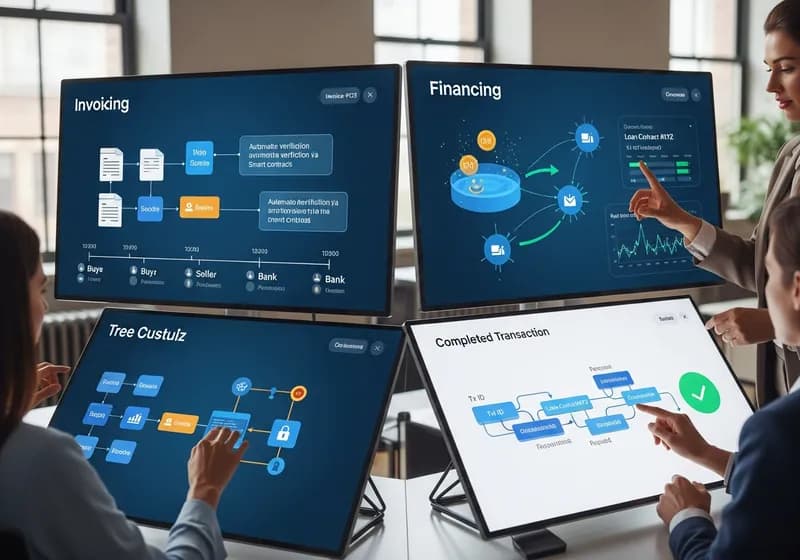
Step 1: Invoice Documentation#
Required:
- Invoice copy
- Purchase order
- Proof of delivery
- Customer credit assessment
- Payment history
Step 2: Smart Contract#
Functions:
- Verify invoice authenticity
- Escrow funds until payment
- Distribute to token holders
- Handle disputes
- Track metrics
Step 3: Token Issuance#
- Create unique invoice tokens
- Set discount rate
- Marketing to investors
- Settle trades
Step 4: Payment & Settlement#
- Customer pays invoice
- Funds released to platform
- Distributed pro-rata to token holders
- Settlement: T+1
Investment Opportunities#
Invoice Portfolio Strategy ($100K)#
Allocation:
- 50% High-quality invoices ($50K): 8% yield
  (Fortune 500 buyers, payment track record)
- 30% Mid-quality ($30K): 15% yield
  (Mid-market companies, standard terms)
- 20% Specialist invoices ($20K): 20% yield
  (e-commerce, contractors, higher risk)

Expected return:
- Blended yield: 11.4% = $11,400 annually
- Hold period: 30-90 days average
- Liquidity: Constant token maturities
- Risk: Diversified across buyers/sellers

Advantages:
- Short-term, low-risk returns
- Constant cash flow (rolling portfolio)
- Defensive positioning (collateralized by physical sales)
- Tax-efficient (short-term gains averaged)
Benefits & Risks#
Benefits for SMEs#
✅ Immediate cash (same day vs. 60+ days) ✅ Lower costs (8-15% vs. 12-20% factoring) ✅ Flexibility (invoice-by-invoice) ✅ No long-term commitments ✅ Credit-quality based pricing ✅ Scalable (repeat process)
Benefits for Investors#
✅ Short-term fixed returns (30-90 days) ✅ Transparent collateral (underlying invoice) ✅ Diversified across buyers ✅ Secured by physical sales (not credit) ✅ Rolling income stream ✅ 8-20% yields available
Risks#
⚠️ Buyer default: Customer doesn't pay invoice
- Mitigation: Buyer credit quality, insurance
⚠️ Fraud: Fake invoices submitted
- Mitigation: Verification protocols, KYC lenders
⚠️ Disputes: Customer contests invoice
- Mitigation: Smart contract escrow, dispute resolution
Market Size#
Invoice Financing Opportunity:
- 2024: $3B-$5B tokenized
- 2025: $8B-$15B
- 2028: $50B+ (mainstream)
Key Markets:
- B2B e-commerce
- Professional services
- Manufacturing
- Logistics
Case Study: $50K Invoice Financing#
Company: Logistics provider
Invoice: Shipment to electronics retailer
- Amount: $50,000
- Payment terms: Net 45 days
- Buyer: Mid-tier credit quality
Current Factoring:
- Factor fee: 15% = $7,500
- Net received: $42,500
- Effective cost: 15% for 45 days = 120% annualized
- Time: 3-5 days
Tokenized Alternative:
- Discount: 3% = $1,500
- Net received: $48,500
- Effective cost: 3% for 45 days = 24% annualized
- Time: 2 hours
Savings: $6,000 (80% cost reduction)
Investor Side:
- Investment: $48,500
- Return: $50,000 (45 days later)
- Profit: $1,500
- Yield: 3% for 45 days = 24% annualized
- Credit profile: Mid-market, standard risk
Economic Impact:
- Supplier: Positive cash flow, 80% cost savings
- Investor: 24% annualized yield (acceptable for credit risk)
- Buyer: No impact (still pays full amount on due date)
- Market: $50K capital recycled, productivity improved
Getting Started#
For SMEs#
- Register: Complete KYC on platform
- Submit: Invoice documentation
- Value: Platform prices invoice (discount rate)
- Accept: Agree to terms
- Receive: Funds instantly
- Repay: Customer pays (automatic distribution)
For Investors#
- Register: Complete accreditation verification
- Fund: Add capital to account
- Browse: View available invoices
- Analyze: Assess buyer credit/risk
- Invest: Purchase invoice tokens
- Receive: Repayment when invoice paid
Regulatory Framework#
US Regulations:
- Reg D private placement (accredited investors)
- UCC filing for security interest
- Form D filing if needed
- State law compliance (varies)
International:
- EU: MiCA compliance (financial instrument)
- UAE: VARA framework (asset-backed)
- Singapore: MAS oversight
FAQ#
Q: What if customer doesn't pay? A: Depends on structure. Usually recourse to supplier; insurance options available.
Q: How long until repayment? A: 30-90 days typically (invoice payment terms).
Q: Can I get my money back early? A: Secondary market trading available (developing liquidity).
Q: How much can I borrow? A: 70-95% of invoice face value typically.
Q: What are costs? A: Platform fee (0.5-1%) + discount (1-8% depending on buyer credit).
Q: Tax implications? A: Ordinary income on discount received. Consult tax advisor.
Conclusion#
Invoice tokenization transforms SME working capital financing by enabling immediate liquidity at lower costs. With $2T+ in unpaid invoices globally and investors seeking 8-20% returns, tokenized invoice platforms create win-win opportunities for both capital-constrained SMEs and yield-seeking investors.
Tokenize your invoices on Pedex today.
Learn More: Real-World Assets Tokenization#
Comprehensive RWA Guide:
→ Tokenizing Real-World Assets: Real Estate, Supply Chain & Finance in 2025 - Complete RWA tokenization framework
Related Financial Assets Articles:
- Supply Chain Finance Through Asset Tokenization - Supply chain finance
- Private Credit Tokenization: Access to Alternative Lending - Private credit
- Tokenized Investment Funds: Structure & Compliance 2025 - Tokenized funds
Enterprise:
- Best Tokenization Platforms 2025: Enterprise Comparison Guide - Platform comparison
Next Steps:
- Start Here - Improve cash flow
- Contact Our SME Finance Team - Get guidance
Ready to improve cash flow? Start Here