
Layer 1 vs Layer 2 for Security Tokens: Speed, Cost & Compliance Compared
Scaling decision guide: This article compares Layer 1 and Layer 2 solutions for security tokens. For comprehensive blockchain technology guidance, see Blockchain Security & Token Technology: 2025 Reference Guide.
Gas fees. Transaction speed. Security guarantees. The choice between Layer 1 and Layer 2 deployment for security tokens can mean the difference between a $0.50 transfer and a $50 one—without sacrificing compliance or security.
This guide breaks down everything you need to know to make the right scaling decision for your tokenized assets.
For foundational understanding, see our Ultimate Guide to Tokenization and RWA. Compare blockchain architectures in our Public vs Private Blockchain guide.
Quick Comparison Summary#
| Factor | Layer 1 (Ethereum) | Layer 2 (Polygon, Arbitrum, etc.) | Winner |
|---|---|---|---|
| Gas Cost (token transfer) | $1-$10 | $0.001-$0.10 | L2 |
| Transaction Speed | 12-15 seconds | 1-4 seconds | L2 |
| Throughput (TPS) | 15-30 | 2,000-40,000+ | L2 |
| Security | Maximum (base layer) | Inherited (with tradeoffs) | L1 |
| Decentralization | Highest | Varies by L2 | L1 |
| Finality | ~15 minutes | Varies (instant to 7 days) | Depends |
| Liquidity | Deepest | Growing rapidly | L1 (for now) |
| Compliance Support | Mature | Emerging | L1 |
| DeFi Integration | Most extensive | Growing | L1 |
| Institutional Adoption | Established | Accelerating | L1 |
Understanding Layer 1 vs Layer 2#
What is Layer 1?#
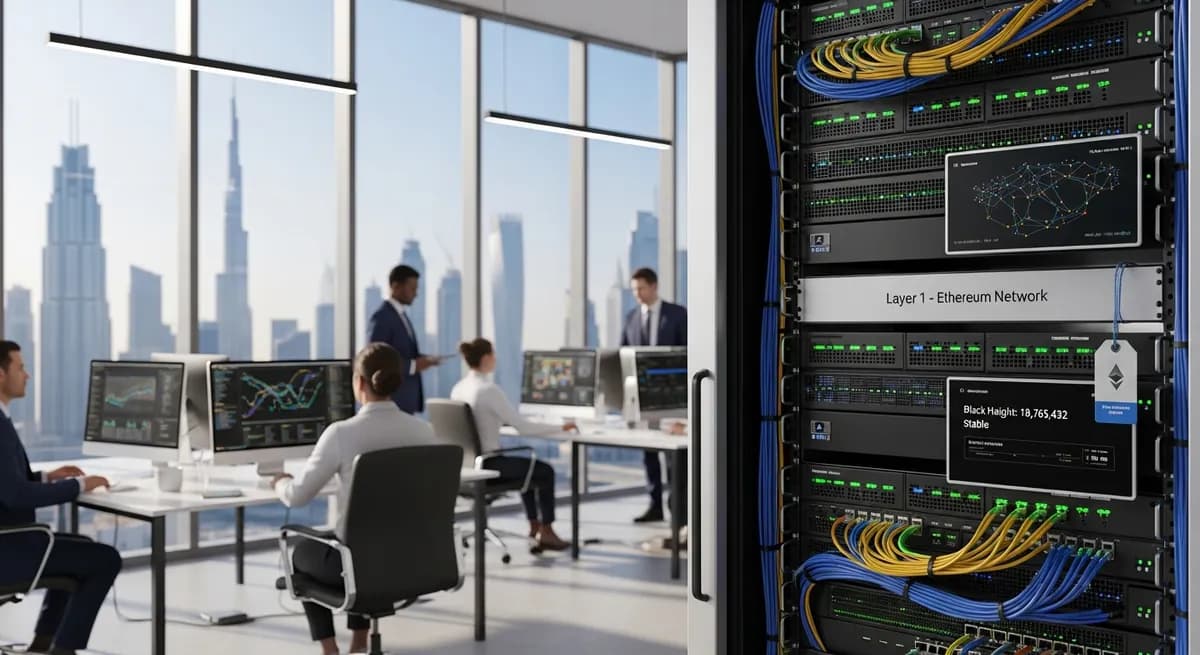
Layer 1 refers to the base blockchain protocol—the fundamental settlement layer.
For security tokens, this typically means:
- Ethereum Mainnet: The dominant L1 for security tokens
- Other L1s: Avalanche, Solana, Tezos (smaller market share)
Characteristics:
- Maximum decentralization
- Highest security guarantees
- Direct settlement on base layer
- Higher gas costs
- Slower transactions
What is Layer 2?#
Layer 2 solutions are scaling protocols built on top of Layer 1 that:
- Process transactions off the main chain
- Periodically settle to L1 for security
- Inherit L1's security model
- Offer dramatically lower costs
Major L2 Types:
| Type | How It Works | Examples |
|---|---|---|
| Optimistic Rollups | Assume transactions valid, allow challenges | Arbitrum, Optimism, Base |
| ZK Rollups | Use cryptographic proofs | zkSync, StarkNet, Polygon zkEVM |
| Validium | Off-chain data, on-chain proofs | Immutable X, Polygon Miden |
| Sidechains | Separate chain with bridge | Polygon PoS |
Gas Cost Comparison#
Real Transaction Costs (December 2025)#
| Operation | Ethereum L1 | Polygon PoS | Arbitrum | Base | Optimism |
|---|---|---|---|---|---|
| ERC-20 Transfer | $1.50-$8 | $0.001 | $0.02 | $0.01 | $0.02 |
| ERC-3643 Transfer | $3-$15 | $0.01 | $0.08 | $0.05 | $0.08 |
| Security Token Mint | $5-$25 | $0.02 | $0.15 | $0.10 | $0.15 |
| Compliance Check | $2-$10 | $0.005 | $0.05 | $0.03 | $0.05 |
| Contract Deployment | $50-$500 | $0.50 | $2-$10 | $1-$5 | $2-$10 |
Annual Cost Projection#
Scenario: 100,000 token transfers per year
| Network | Cost per Transfer | Annual Cost | Savings vs L1 |
|---|---|---|---|
| Ethereum L1 | $5.00 | $500,000 | — |
| Polygon PoS | $0.01 | $1,000 | 99.8% |
| Arbitrum | $0.08 | $8,000 | 98.4% |
| Base | $0.05 | $5,000 | 99.0% |
| Optimism | $0.08 | $8,000 | 98.4% |
Winner: Layer 2 (10-500x cheaper)
Transaction Speed & Finality#
Speed Comparison#
| Network | Block Time | Soft Finality | Hard Finality |
|---|---|---|---|
| Ethereum L1 | 12 sec | 12 sec | ~15 min (32 epochs) |
| Polygon PoS | 2 sec | 2 sec | ~2-3 min (checkpoints) |
| Arbitrum | ~1 sec | ~1 sec | ~7 days (fraud proof window) |
| Base | ~1 sec | ~1 sec | ~7 days |
| Optimism | 2 sec | 2 sec | ~7 days |
| zkSync Era | ~1 sec | ~1 sec | ~1 hour (proof generation) |
Understanding Finality for Security Tokens#
Soft Finality: Transaction confirmed on L2 (fast)
- Safe for most operations
- Used for daily trading
- Sufficient for internal transfers
Hard Finality: Transaction settled on L1 (slower)
- Required for large transfers
- Critical for cross-chain bridges
- Important for institutional compliance
For Security Tokens:
- Daily trading: Soft finality sufficient (seconds)
- Large institutional transfers: May wait for L1 finality
- Regulatory reporting: Hard finality timestamps
Winner: Tie (depends on use case)
Security Analysis#
Ethereum Layer 1 Security#
Security Model:
- 900,000+ validators
- $80B+ staked ETH
- 8+ years of battle testing
- Economic attack cost: $50B+
Risk Profile:
- Smart contract vulnerabilities (user responsibility)
- MEV/front-running (mitigatable)
- Network congestion (variable costs)
Layer 2 Security Models#
Optimistic Rollups (Arbitrum, Optimism, Base)
Security Model:
- Transactions assumed valid
- 7-day challenge window
- Fraud proofs if invalid
Risks:
- Sequencer centralization (temporary)
- Challenge period delays withdrawals
- Relies on at least one honest verifier
Security Inheritance: ~95% of L1 security
ZK Rollups (zkSync, Polygon zkEVM)
Security Model:
- Mathematical proofs validate transactions
- No challenge period
- Cryptographic guarantees
Risks:
- Complex cryptography (newer, less tested)
- Proof generation delays
- Prover centralization
Security Inheritance: ~98% of L1 security
Sidechains (Polygon PoS)
Security Model:
- Own validator set
- Checkpoints to Ethereum
- Independent consensus
Risks:
- Smaller validator set
- Bridge vulnerabilities
- Separate security budget
Security Inheritance: ~70-80% of L1 security
Security Winner by Use Case#
| Use Case | Recommended | Reason |
|---|---|---|
| $100M+ AUM fund | L1 or ZK Rollup | Maximum security |
| Retail token trading | Any L2 | Cost efficiency |
| Institutional custody | L1 | Proven track record |
| High-frequency trading | Optimistic L2 | Speed + sufficient security |
| Regulatory-sensitive | L1 or ZK Rollup | Clearer audit trail |
Compliance & Token Standards#
ERC-3643 Support by Network#
| Network | ERC-3643 Support | Audited Implementations | Notes |
|---|---|---|---|
| Ethereum L1 | ✅ Full | Multiple | Industry standard |
| Polygon PoS | ✅ Full | Multiple | Widely deployed |
| Arbitrum | ✅ Full | Limited | Growing adoption |
| Base | ✅ Full | Limited | Coinbase ecosystem |
| Optimism | ✅ Full | Limited | OP Stack compatible |
| zkSync Era | ⚠️ Partial | Experimental | ZK-specific adaptations |
For token standard comparison, see ERC-3643 vs ERC-1400: Security Token Standards.
Compliance Considerations by L2#
Polygon PoS:
- Most mature L2 for compliance
- Used by major institutions
- Clear regulatory track record
- Multiple KYC/AML integrations
Arbitrum:
- Growing institutional adoption
- Compliance tools emerging
- Strong technical foundation
- Fraud proofs add transparency
Base:
- Coinbase regulatory backing
- US-friendly positioning
- KYC integration native
- Institutional credibility
Optimism:
- Similar to Arbitrum
- Open-source focus
- Governance token considerations
Compliance Winner#
Polygon PoS and Base lead for compliance-sensitive deployments:
- Mature ecosystems
- Institutional backing
- Regulatory clarity
- KYC/AML integrations
Liquidity & DeFi Integration#
Total Value Locked (TVL) by Network#
| Network | TVL (Dec 2025) | Security Token TVL | DeFi Protocols |
|---|---|---|---|
| Ethereum L1 | $50B+ | $5B+ | 500+ |
| Arbitrum | $15B+ | $200M+ | 300+ |
| Polygon PoS | $1B+ | $100M+ | 400+ |
| Base | $8B+ | $50M+ | 200+ |
| Optimism | $5B+ | $30M+ | 200+ |
DeFi Use Cases for Security Tokens#
| Use Case | L1 Support | L2 Support | Best Option |
|---|---|---|---|
| Lending collateral | ✅ Aave, Compound | ✅ Aave V3 (all L2s) | Either |
| DEX trading | ✅ Uniswap | ✅ Uniswap V3 | L2 (lower fees) |
| Yield aggregation | ✅ Yearn | ✅ Beefy | Either |
| RWA protocols | ✅ Centrifuge, Maple | ⚠️ Limited | L1 (for now) |
| Institutional custody | ✅ Fireblocks, Anchorage | ⚠️ Emerging | L1 |
Liquidity Winner#
Ethereum L1 maintains deepest liquidity, but L2s are rapidly catching up for:
- Token trading (Uniswap V3 on all major L2s)
- Lending (Aave V3 multi-chain)
- Institutional access (Coinbase → Base)
Platform Support Matrix#
| Platform | Ethereum L1 | Polygon | Arbitrum | Base | Optimism | zkSync |
|---|---|---|---|---|---|---|
| Pedex | ✅ | ✅ | ✅ | Planned | — | — |
| Securitize | ✅ | ✅ | — | — | — | — |
| Tokeny | ✅ | ✅ | — | — | — | — |
| DigiShares | ✅ | ✅ | — | — | — | — |
| Polymath | ✅ (Polymesh) | — | — | — | — | — |
For detailed platform comparison, see Best Tokenization Platforms 2025.
L2 Selection Framework#
Decision Tree#
Start
  │
  ├─ Need maximum security & liquidity?
  │   └─ YES → Ethereum L1
  │
  ├─ Cost-sensitive with high volume?
  │   └─ YES → Continue ↓
  │
  ├─ Need Coinbase ecosystem integration?
  │   └─ YES → Base
  │
  ├─ Want most mature L2 ecosystem?
  │   └─ YES → Arbitrum
  │
  ├─ Require fastest proof finality?
  │   └─ YES → zkSync or Polygon zkEVM
  │
  └─ Want proven security token deployments?
      └─ YES → Polygon PoS
Recommendations by Use Case#
| Use Case | Recommended Network | Reason |
|---|---|---|
| Real estate tokenization | Polygon PoS | Proven, low cost, compliance ready |
| Institutional securities | Ethereum L1 | Maximum security, liquidity |
| High-volume trading | Arbitrum | Speed + security balance |
| US-focused offering | Base | Coinbase regulatory advantage |
| DeFi-integrated tokens | Arbitrum or Polygon | Best DeFi ecosystems |
| Privacy-sensitive | zkSync Era | ZK privacy features |
| Multi-chain strategy | Start L2, bridge to L1 | Cost-effective scaling |
Migration & Bridging#
L1 to L2 Migration#
Process:
- Deploy contracts on L2
- Set up canonical bridge
- Snapshot L1 token holders
- Mint equivalent tokens on L2
- Lock L1 tokens (or burn)
- Update integrations
Timeline: 2-4 weeks Cost: $50K-$150K
L2 to L1 Migration#
Process:
- Deploy/verify L1 contracts
- Configure bridge (unlock mechanism)
- Coordinate holder migration
- Handle fraud proof window (7 days for Optimistic)
- Update compliance registries
Timeline: 3-6 weeks Cost: $75K-$200K
Multi-Chain Deployment#
Architecture:
                    ┌─────────────┐
                    │ Token Logic │
                    └──────┬──────┘
                           │
           ┌───────────────┼───────────────┐
           │               │               │
    ┌──────▼──────┐ ┌──────▼──────┐ ┌──────▼──────┐
    │ Ethereum L1 │ │   Polygon   │ │  Arbitrum   │
    │   (Main)    │ │ (Low Cost)  │ │  (DeFi)     │
    └─────────────┘ └─────────────┘ └─────────────┘
           │               │               │
           └───────────────┼───────────────┘
                           │
                    ┌──────▼──────┐
                    │   Bridge    │
                    │  Protocol   │
                    └─────────────┘
Benefits:
- Access different user bases
- Optimize for different use cases
- Hedge against single-chain risk
Cost-Benefit Analysis#
5-Year TCO Comparison#
Assumptions: 500,000 annual transactions, $10M tokenized assets
| Cost Category | Ethereum L1 | Polygon PoS | Arbitrum |
|---|---|---|---|
| Year 1 Setup | $300K | $250K | $275K |
| Annual Gas | $2.5M | $5K | $40K |
| Infrastructure | $50K | $50K | $50K |
| 5-Year Total | $12.85M | $525K | $725K |
| Cost per Tx | $5.14 | $0.21 | $0.29 |
Break-Even Analysis:
- L2 beats L1 at ~10,000 transactions/year
- ROI on L2 migration: 500%+ at scale
Risk Considerations#
L2-Specific Risks#
| Risk | Impact | Mitigation |
|---|---|---|
| Sequencer downtime | Temporary inability to transact | Multi-sequencer setups, L1 fallback |
| Bridge exploits | Loss of bridged funds | Use canonical bridges, insurance |
| Regulatory uncertainty | Compliance questions | Choose L2s with clear legal backing |
| Protocol upgrades | Potential breaking changes | Monitor governance, plan migrations |
| Fraud proof failures | Invalid state (Optimistic) | Multiple verifiers, monitoring |
Risk Mitigation Strategies#
- Start on proven L2 (Polygon, Arbitrum)
- Maintain L1 deployment option
- Use audited bridges only
- Monitor sequencer health
- Keep upgrade paths open
For security best practices, see Smart Contract Security Audit Checklist.
Future Outlook (2025-2027)#
Emerging Trends#
Layer 2 Dominance:
- 80%+ of security token transactions expected on L2 by 2027
- L1 becomes "settlement layer" for high-value finality
ZK Rollup Maturation:
- Faster proof generation
- Better EVM compatibility
- Privacy-preserving compliance
Cross-L2 Interoperability:
- Shared liquidity layers
- Seamless bridging
- Unified user experience
Institutional L2 Adoption:
- Major banks deploying on L2
- Regulated stablecoins native to L2
- Compliance frameworks maturing
Frequently Asked Questions#
Q: Is Layer 2 safe for security tokens? A: Yes, major L2s (Arbitrum, Polygon, Base) have processed billions in value. Security inherits from Ethereum L1. For maximum security, use ZK rollups.
Q: Can I deploy ERC-3643 on Layer 2? A: Yes, ERC-3643 works on all EVM-compatible L2s. Compliance modules deploy identically.
Q: What about regulatory concerns with L2? A: L2 transactions are ultimately settled on Ethereum, providing regulatory clarity. Polygon and Base have strong institutional backing.
Q: How do I choose between Arbitrum and Polygon? A: Polygon for proven compliance ecosystems and low costs. Arbitrum for DeFi integration and growing institutional adoption.
Q: What's the risk of L2 shutting down? A: Users can always exit to L1 via escape hatches. Assets are never locked permanently. Choose L2s with strong governance and funding.
Q: Should I deploy on multiple L2s? A: Consider if you need different user bases or use cases. Start with one L2, expand based on demand.
Conclusion#
For most security token projects in 2025, Layer 2 is the optimal choice:
- 90%+ cost savings vs Ethereum L1
- Faster transactions (seconds vs minutes)
- Sufficient security (inherited from Ethereum)
- Growing compliance ecosystems
Choose Ethereum L1 for:
- Maximum security requirements
- Institutional-grade custody needs
- Deep DeFi liquidity access
Choose Layer 2 for:
- Cost-sensitive deployments
- High-volume trading
- Retail accessibility
- Speed requirements
Start with Polygon PoS or Arbitrum for the best balance of cost, security, and ecosystem maturity.
Related Resources#
Technical Guides:
- Blockchain Security & Token Technology: 2025 Reference Guide - Complete technical reference
- Public vs Private Blockchain for Asset Tokenization - Architecture comparison
- ERC-3643 vs ERC-1400: Security Token Standards - Token standard comparison
- Smart Contract Security Audit Checklist - Security framework
Platform Selection:
- Best Tokenization Platforms 2025 - Enterprise platform guide
- Platform Comparison 2025 - Feature comparison
Investment Guides:
- How to Invest in Tokenized Assets - Complete investor guide
- Tokenization Platform Security: Investors Guide - Security for investors
Learning Center:
- Ultimate Guide to Tokenization and RWA - Comprehensive foundation
Need help selecting the right Layer solution? Contact our technical team for a personalized architecture consultation.
Disclaimer: This guide is for informational purposes only. Blockchain technology and costs change rapidly. Gas prices are indicative and vary based on network conditions. Consult technical advisors for specific implementation decisions.