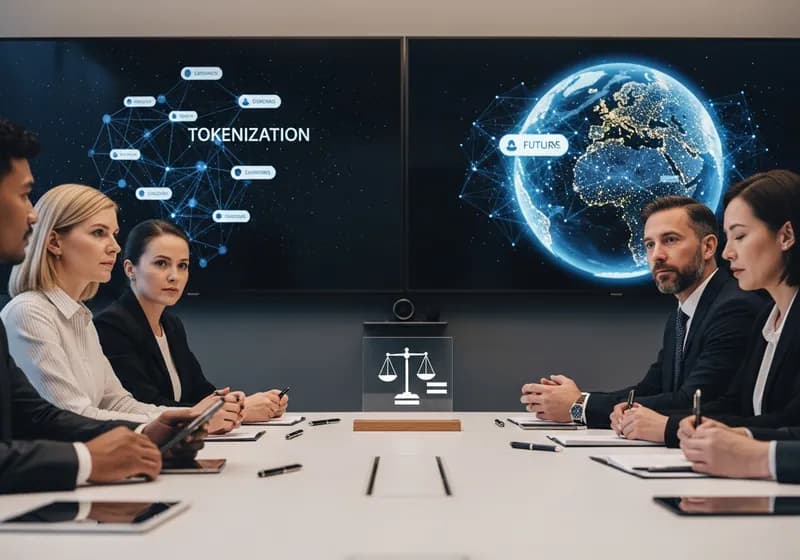

Tokenization and the Future of Justice: Will Digital Assets Heal or Hijack Global Inequality?
A Civilizational Manifesto on Ownership, Power, and the Code of the New Economy
Every major turning point in economic history has quietly rewritten the definition of justice. Feudal land ownership shaped medieval hierarchy. Industrial capital redrew the map of class and labor. The digital era transformed information into power. Today, tokenization is reshaping the very logic of ownership itself—not on paper, not in vaults, but inside immutable digital ledgers.
Tokenization is often presented as a technical innovation: the conversion of real-world assets into digital tokens on blockchain networks. But beneath its technical surface lies a question far more dangerous and far more profound:
Will tokenization become the greatest instrument of economic justice ever created—or the most efficient machine for amplifying global inequality in human history?
This is not a question for programmers alone. It is a question for civilizations.
For comprehensive context on tokenization fundamentals, see our Ultimate Guide to Tokenization and RWA. Explore the geopolitical dimensions in our pillar article on Tokenization as a Geopolitical Weapon.
Table of Contents#
- What Tokenization Really Means Beyond Technology
- Justice as Access, Not Charity
- The Great Promise: A New Architecture of Economic Participation
- The Dark Reflection: How Tokenization Can Amplify Injustice
- Why the World Avoids the Justice Discussion
- Tokenization as a Civilizational Test
- Designing Justice Into the Code
- Inequality in the Digital Asset Age
- The Future Scenarios
- The Real Question No One Wants to Ask
What Tokenization Really Means Beyond Technology#
In mainstream finance, tokenization is defined as:
The representation of an asset—real estate, commodities, securities, infrastructure, debt, or intellectual property—into digital tokens that can be transferred and traded on blockchain networks.
But this description is incomplete. Tokenization is not merely the digitalization of assets. It is the digitalization of access to power, capital, and participation.
Tokenization reconstructs three foundational pillars of economic civilization:
| Pillar | Traditional Question | Tokenized Question |
|---|---|---|
| Ownership | Who is allowed to own? | Who can hold a token? |
| Liquidity | Who can enter and exit value? | Who has access to markets? |
| Participation | Who is allowed to play the game? | Who can afford the minimum? |
These were once controlled by states, banks, and elite capital institutions. Tokenization threatens to dissolve those gates—or to rebuild them with far more opaque algorithms.
For a deeper dive into how this restructuring affects different asset classes, explore our guide on Real-World Assets Tokenization.
Justice as Access, Not Charity#
Economic justice is often misunderstood as redistribution. In reality, true economic justice is access:
- Access to ownership
- Access to opportunity
- Access to capital formation
- Access to wealth-building systems
For most of modern history, access to asset ownership has been structurally restricted. Entire populations were locked out of:
- Commercial real estate
- Industrial production
- Infrastructure projects
- Financial instruments
- Sovereign capital flows
Not by law alone—but by scale, cost, regulation, and institutional barriers.
Tokenization breaks these barriers structurally. A single power plant, port, warehouse, or income-producing asset can be divided into millions of digital units. A construction project once reserved for banks and billionaires can suddenly become participatory.
This is not symbolic inclusion. This is mathematical inclusion.
Learn how fractional ownership works in practice in our Residential Property Fractionalization Guide.
The Great Promise: A New Architecture of Economic Participation#
If designed correctly, tokenization can unlock four revolutionary justice mechanisms:
I. Fractional Ownership at Planetary Scale#
A $100-million asset can be owned by 10 million individuals. This alone reshapes the DNA of capitalism.
Traditional Model:
- Minimum investment: $1,000,000+
- Investors: ~100 institutional players
- Geographic reach: Single jurisdiction
Tokenized Model:
- Minimum investment: $10-$100
- Investors: Potentially millions globally
- Geographic reach: Borderless
II. Global Liquidity Without Gatekeepers#
Capital no longer waits for banks. Value can move peer-to-peer, instantaneously, across borders.
The implications are profound:
- No 3-day settlement periods
- No correspondent banking fees
- No currency conversion friction
- No banking hour restrictions
III. Transparent Ownership Records#
Public blockchains expose structures of control and eliminate hidden monopolies. When ownership is recorded on-chain:
- Concentration becomes visible
- Beneficial ownership becomes traceable
- Market manipulation becomes detectable
- Accountability becomes enforceable
IV. Direct Capital-Project Connection#
Investors no longer feed institutions. They feed projects directly.
This disintermediates the rent-seeking layers that have historically extracted value between capital and productive assets.
In theory, tokenization could shift the world from extractive finance to participatory finance.
For analysis of how this plays out in specific markets, see our GCC Markets Guide.
The Dark Reflection: How Tokenization Can Amplify Injustice#
Every justice technology carries within it the potential for accelerated domination.
A. Infrastructure Capture#
The earliest controllers of tokenization platforms may control not just wealth—but the pipelines of wealth forever.
Consider:
- Who builds the blockchains?
- Who sets the token standards?
- Who operates the custodians?
- Who writes the compliance logic?
The first movers in infrastructure capture the rails upon which all future value must travel.
B. Algorithmic Wealth Monopolies#
Those who understand the code before others accumulate assets at exponential speed.
Information asymmetry in tokenized markets:
- Technical literacy requirements
- Early access to token launches
- Understanding of smart contract mechanics
- Ability to audit code before investing
The digital divide becomes a wealth divide becomes a permanent structural divide.
C. Tokenized Colonialism#
Wealthy jurisdictions may tokenize and absorb the productive assets of weaker regions digitally—without troops, wars, or political invasions.
The mechanism:
- Identify undervalued assets in developing economies
- Tokenize through favorable regulatory arbitrage
- Distribute tokens to wealthy-nation investors
- Extract returns without local reinvestment
This is colonialism upgraded for the digital age.
D. Commodification of Human Struggle#
Debt, poverty, carbon emissions, even disaster recovery may be tokenized and traded.
When everything becomes a tradeable asset:
- Human suffering becomes a financial instrument
- Crisis becomes an investment opportunity
- Social problems become profit centers
In such a world, inequality does not disappear. It becomes liquid, global, and invisible.
For more on these dynamics, read our analysis of The Hidden Economy of RWA: Who Really Gets Rich.
Why the World Avoids the Justice Discussion#
Global institutions speak extensively about:
- Efficiency
- Liquidity
- Innovation
- Market expansion
But they rarely speak about:
- Ownership ethics
- Power distribution
- Civilizational consequences
- Long-term inequality
Why?
Because if justice becomes central to tokenization discourse, the legitimacy of today's financial order collapses.
Tokenization forces a question modern finance cannot answer comfortably:
Who truly deserves ownership in a digitized world?
This question threatens:
- Inherited wealth structures
- Institutional gatekeeping powers
- Regulatory capture mechanisms
- The narrative of meritocratic capitalism
The silence around justice is not accidental. It is strategic.
Tokenization as a Civilizational Test#
Tokenization is not merely a fintech innovation. It is a moral stress test for human economic systems.
It asks:
| Question | Traditional Answer | Tokenized Question |
|---|---|---|
| Should access to capital be inherited or earned? | Largely inherited | Open for redesign |
| Should ownership be scarce or distributed? | Artificially scarce | Programmably distributable |
| Should wealth circulate or stagnate? | Tends to stagnate | Can be programmed to circulate |
| Should digital power serve humanity or algorithmic elites? | Often serves elites | Architecture-dependent |
Civilizations are not judged by how fast they innovate—but by who they allow to benefit from innovation.
The tokenization moment is a civilizational inflection point. The choices made now will echo for generations.
Designing Justice Into the Code#
Justice will not emerge spontaneously from blockchains, smart contracts, or protocols. Justice must be architected.
A justice-oriented tokenization framework requires:
Structural Requirements#
-
Public transparency by default
- All ownership records accessible
- All fee structures visible
- All governance decisions logged
-
Ownership concentration limits
- Maximum token holdings per wallet
- Anti-whale mechanisms
- Progressive fee structures
-
Governance rights for token holders
- Voting on major decisions
- Proposal mechanisms
- Transparent execution
-
Anti-monopoly token design
- Preventing infrastructure capture
- Ensuring competitive markets
- Breaking network effects before they calcify
-
Clear separation between speculation and utility
- Distinguishing investment tokens from access tokens
- Preventing financialization of basic services
-
Universal access layers for participation
- Low minimum investments
- Multi-language interfaces
- Offline-compatible systems
Without these, tokenization becomes merely financialization accelerated.
For technical implementation considerations, see our Smart Contract Audit Checklist.
Inequality in the Digital Asset Age#
Traditional inequality grew linearly.
Digital inequality grows exponentially.
- Early access compounds
- Information advantage compounds
- Infrastructure advantage compounds
Tokenization does not merely move money faster—it moves compounding advantage faster.
The Mathematics of Digital Inequality#
Consider two investors:
- Investor A: Early adopter, technical literacy, $10,000 initial investment
- Investor B: Late adopter, limited technical knowledge, $10,000 initial investment
After 5 years in a tokenized ecosystem:
- Investor A: $150,000+ (early access premiums, governance rewards, information advantages)
- Investor B: $12,000 (retail access only, no governance participation, information lag)
The gap is not additive. It is multiplicative.
Justice Requires Temporal Correction#
- Slow private capture through delayed token unlocks
- Speed public participation through universal access mechanisms
- Regulate early monopolies before they become permanent
- Protect late entrants through anti-dilution mechanisms
Otherwise, the digital wealth gap will exceed every historical precedent.
The Future Scenarios#
Scenario 1: Tokenization as a Global Justice Engine#
Characteristics:
- Ownership becomes participatory
- Wealth circulates broadly
- Power decentralizes gradually
- Financial sovereignty expands
Requirements:
- Public blockchain infrastructure
- Open-source token standards
- Distributed governance
- Universal access design
Probability: Possible but requires active intervention
Scenario 2: Tokenization as Controlled Neutral Infrastructure#
Characteristics:
- Markets stabilize
- Efficiency rises significantly
- Inequality remains—but does not explode
- Power shifts but concentrates differently
Requirements:
- Regulatory frameworks
- Institutional adoption
- Compliance infrastructure
- Professional intermediaries
Probability: Most likely default path
Scenario 3: Tokenization as Hyper-Extraction Machine#
Characteristics:
- Assets concentrate rapidly
- Power disappears into algorithms
- Society fractures into digital landlords and digital labor
- Invisible extraction replaces visible exploitation
Requirements:
- Unregulated development
- Private infrastructure capture
- Information asymmetry preservation
- Justice discourse suppression
Probability: High without intentional intervention
The difference between these futures does not lie in code alone. It lies in civilizational governance choices made today.
For more on these competing visions, see CBDCs vs Tokenized Assets: The War for Monetary Control.
The Real Question No One Wants to Ask#
The real question is not:
"Can tokenization increase efficiency?"
The real question is:
"Who gets to own the future if everything becomes tokenized?"
If justice is excluded from this question, history will repeat—only faster, colder, and on a global digital scale.
The stakeholders who should be asking this question:
- Regulators designing frameworks
- Developers writing protocols
- Investors allocating capital
- Citizens demanding accountability
- Institutions claiming legitimacy
If none of them ask, the question will be answered by default—by those who move fastest without moral constraint.
Conclusion: Tokenization Is Not Neutral—It Is a Choice#
Tokenization is not destiny. It is design.
It can be:
- A ladder out of historical exclusion
- Or a perfected machine of inequality
It can:
- Democratize ownership
- Or hyper-centralize control
It can:
- Rebuild trust
- Or automate exploitation
Tokenization will not decide the fate of justice. Humanity will.
And the answer will not be found in whitepapers or venture capital decks. It will be found in how ownership is allowed to circulate when everything becomes code.
Common Questions (FAQ)#
Is tokenization inherently just or unjust?#
Neither. Tokenization is infrastructure. Like roads or electricity, its justice impact depends entirely on design choices, governance structures, and regulatory frameworks.
Can tokenization really democratize ownership?#
Technically, yes. Practically, only if designed with access as a priority. Without intentional justice architecture, tokenization can easily reproduce and accelerate existing inequalities.
Who benefits most from tokenization today?#
Currently: early adopters, technical experts, platform operators, and institutional investors with regulatory access. This distribution is not inevitable—but it is the default.
What would just tokenization look like?#
Low barriers to entry, transparent governance, distributed infrastructure, universal access design, and regulatory frameworks that prioritize participation over extraction.
Is it too late to influence the direction of tokenization?#
No. We are still in early infrastructure development. The next 5-10 years will determine foundational standards. Active engagement now can shape outcomes for generations.
Further Reading#
Explore our strategic analysis series on power and tokenization:
- Tokenization as a Geopolitical Weapon: The New Financial Empire Architecture
- From DeFi to DeEmpire: Engineering Financial Empires
- Tokenizing Poverty and Wealth: Blockchain and Social Classes
- The Hidden Economy of RWA: Who Really Gets Rich?
- Sovereign Wealth Funds 2.0: How Blockchain Will Rule Capital
The question is not whether tokenization will transform civilization. It already is.
The question is whether that transformation will serve justice—or bury it deeper than ever before.
This analysis is for strategic understanding. Tokenization involves complex legal, regulatory, and technical considerations. The future is not determined—it is contested. Engage accordingly.