

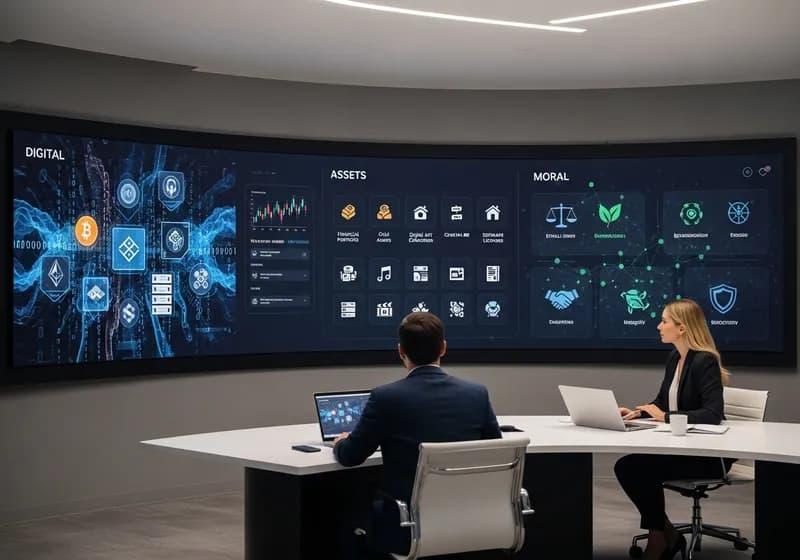
Digital Assets, Moral Collapse, or Economic Justice? The Hidden Philosophy of Tokenization
A Civilizational Inquiry into Ethics, Power, and the Soul of the New Financial Age
Every civilization that believed technology was neutral eventually paid the price for that illusion.
The steam engine reshaped labor and empire. Electricity reshaped industry and war. The internet reshaped truth, identity, and power. Now, digital assets and tokenization are reshaping ownership itself.
Once again, the world celebrates:
- Efficiency
- Speed
- Liquidity
- Innovation
But history teaches us that when societies rush to optimize systems without first interrogating their ethical architecture, what follows is never neutrality—but domination.
Tokenization is not merely a technical advancement. It is the philosophical redesign of economic reality.
And the central question of our time is no longer:
"How do we tokenize assets?"
But rather:
Are digital assets guiding humanity toward economic justice—or accelerating a moral collapse hidden behind cryptographic elegance?
For foundational context, see our Ultimate Guide to Tokenization and RWA. For strategic analysis, explore our pillar on Tokenization as a Geopolitical Weapon.
Table of Contents#
- What Philosophy Has Always Known: Money Is Never Just Money
- The Metaphysics of Tokenized Ownership
- The Illusion of Neutral Technology
- The Great Ethical Paradox of Tokenization
- Moral Collapse Is Not Always Violent
- Tokenization and the Revaluation of Human Life
- Justice as an Engineering Decision
- The Birth of Algorithmic Virtue and Tyranny
- Digital Assets and the Death of Moral Distance
- Tokenization and the Crisis of Economic Meaning
- Does Tokenization Destroy or Rebuild Economic Justice?
- The Forgotten Question: Who Owns the Governance Layer?
- The Reappearance of Feudal Logic in Digital Form
- The Spiritual Vacuum of the Token Economy
- Can Economics Without Morality Survive Digitization?
What Philosophy Has Always Known: Money Is Never Just Money#
Philosophy has always understood something that financial engineering often forgets:
Money is not just a tool of exchange. It is a structure of values.
Every monetary system encodes answers to invisible questions:
| Question | Encoding |
|---|---|
| Who deserves ownership? | Property rights structure |
| Who bears risk? | Contract terms and defaults |
| Who sets the rules? | Governance mechanisms |
| Who is protected? | Regulatory frameworks |
| Who is sacrificed? | Externality distribution |
How Historical Systems Encoded Values#
| System | Core Value Encoded |
|---|---|
| Gold-based systems | Scarcity and physical possession |
| Debt-based systems | Institutional mediation |
| Fiat systems | Sovereign authority |
| Financialization | Abstract capital claims |
| Tokenization | Programmable ownership |
Tokenization now proposes to privilege: programmable ownership.
This is not a minor philosophical shift. This is the relocation of power from law and trust to code and logic.
The Metaphysics of Tokenized Ownership#
In pre-digital civilizations, ownership had metaphysical dimensions:
- Land was sacred
- Labor was bodily
- Wealth was tangible
- Authority was visible
Tokenization strips ownership of physicality and renders it:
- Abstract - Existing as data
- Portable - Moving at light speed
- Fragmented - Divisible infinitely
- Weightless - Without physical presence
- Borderless - Ignoring geography
Ownership becomes a moving line of code.
The New Human Condition#
This ontological transformation produces a new kind of human being:
The disembodied economic subject—owner without land, investor without place, stakeholder without community.
This is not just an economic shift. It is a transformation of human self-perception.
When ownership no longer connects to place, labor, or community, what does it mean to "own" anything at all?
The Illusion of Neutral Technology#
One of the most dangerous assumptions of the digital asset age is this:
"Tokenization is just infrastructure. It has no ideology."
This is false.
Every protocol embeds:
| Element | Hidden Ideology |
|---|---|
| Governance model | Who decides |
| Power distribution logic | Who benefits |
| Inclusion/exclusion mechanism | Who participates |
| Political economy | How value flows |
Neutrality is not the absence of ideology. It is the concealment of ideology inside technical language.
Tokenization does not remove politics from finance. It makes politics invisible to those who cannot read code.
For technical analysis, see our Tokenization API Integration Guide.
The Great Ethical Paradox of Tokenization#
Tokenization simultaneously promises:
| Promise | Counter-Reality |
|---|---|
| Freedom | Surveillance |
| Inclusion | Exclusion |
| Transparency | Manipulation |
| Decentralization | Concentration |
This paradox defines the ethical battlefield of digital assets.
The Same Infrastructure, Different Outcomes#
The same infrastructure that allows:
- A farmer to fractionalize land
- A community to crowdfund energy
- A family to preserve generational wealth
Also allows:
- Corporations to extract invisible rents
- Speculators to drain local economies
- Platforms to become invisible landlords
Tokenization does not solve injustice. It reshapes the battlefield on which injustice is contested.
Moral Collapse Is Not Always Violent—Sometimes It Is Elegant#
When moral collapse arrives, it rarely announces itself with chaos.
More often, it arrives with:
- User-friendly interfaces
- Seamless apps
- Frictionless markets
- Beautiful dashboards
- Automated convenience
Tokenization hides economic violence behind perfect user experience.
The Aesthetics of Extraction#
People do not feel dispossessed. They feel "optimized." People do not feel exploited. They feel "liquid."
| Feeling | Reality |
|---|---|
| Financial freedom | Algorithmic dependency |
| Passive income | Extraction participation |
| Investment opportunity | Wealth transfer mechanism |
| Democratization | Sophisticated capture |
Thus, moral collapse becomes a gentle downward slope disguised as innovation.
For analysis of these dynamics, see The Hidden Economy of RWA: Who Really Gets Rich?.
Tokenization and the Revaluation of Human Life#
A civilization reveals its deepest values through what it chooses to tokenize.
Already, systems are emerging that tokenize:
| Category | Examples |
|---|---|
| Time | Attention tokens |
| Attention | Ad-based value extraction |
| Carbon | Carbon credit markets |
| Labor hours | Time-based tokens |
| Personal data | Data marketplaces |
| Risk exposure | Insurance derivatives |
| Environmental damage | Pollution permits |
| Health metrics | Wellness tokens |
The Ultimate Trajectory#
What is not yet openly discussed is the ultimate trajectory:
When everything becomes an asset, human existence itself becomes a financial derivative.
This is the silent metaphysical danger of tokenization:
Not financial collapse—but the collapse of meaning.
When every aspect of human life has a price, nothing remains sacred. When every moment can be monetized, no moment remains fully human.
Justice as an Engineering Decision, Not a Moral Speech#
In the tokenized world, justice will no longer be declared through:
- Constitutions
- Religious commandments
- Social ethics
It will be declared through:
| Technical Element | Justice Implication |
|---|---|
| Ownership caps | Maximum accumulation limits |
| Governance logic | Decision-making distribution |
| Voting weight algorithms | Power concentration |
| Access permissions | Who can participate |
| Issuance constraints | Who can create value |
Justice becomes a design choice buried inside technical architecture.
The Most Dangerous Moment in Ethical History#
This produces the most dangerous moment in ethical history:
- Ethics without philosophers
- Justice without jurists
- Power without visible rulers
Those who write the code become the silent legislators of economic morality.
For implementation considerations, see Smart Contract Audit Checklist.
The Birth of Algorithmic Virtue and Algorithmic Tyranny#
In classical philosophy:
- Virtue emerged through character
- Tyranny emerged through concentration of power
In the tokenized world:
- Virtue emerges through protocol parameters
- Tyranny emerges through liquidity monopolies
The New Forms of Power#
The tyrant is no longer a king. The tyrant is:
| New Tyrant | Power Mechanism |
|---|---|
| A settlement layer | Controls how value moves |
| A dominant token standard | Defines what ownership means |
| A governance cartel | Makes decisions for all |
| A liquidity gate | Determines who can access markets |
Oppression no longer shouts. It executes.
The algorithm does not debate. It does not justify. It simply runs.
Digital Assets and the Death of Moral Distance#
In older systems, injustice had visible intermediaries:
- Landlords
- Factory owners
- Bankers
- Colonial administrators
Now injustice is executed by:
| Mechanism | Effect |
|---|---|
| Smart contracts | Automatic enforcement |
| Automated liquidations | Instant dispossession |
| Oracle-driven triggers | External data as judge |
| Algorithmic settlements | Mathematical finality |
There is no longer a face to confront. Only dashboards.
The Dilution of Responsibility#
Responsibility becomes statistically diluted:
- The developer wrote the code, but didn't know how it would be used
- The investor funded the protocol, but didn't control its governance
- The user participated in the system, but didn't understand its mechanics
- The regulator observed the market, but couldn't comprehend its logic
And that is where moral collapse accelerates—when no one is responsible because everyone is merely a participant in a system.
Tokenization and the Crisis of Economic Meaning#
Traditional wealth had meaning:
| Wealth Form | Meaning |
|---|---|
| Land | Continuity across generations |
| Gold | Stability and permanence |
| Business | Production and employment |
| Labor | Dignity and contribution |
Tokenized wealth often means only:
Velocity.
- How fast it moves
- How fast it multiplies
- How fast it escapes
Hyper-Financial Nihilism#
When meaning collapses into velocity, civilization enters:
A phase of hyper-financial nihilism.
Nothing is owned for its own sake. Everything is owned for its potential appreciation. No asset has value except as a stepping stone to the next trade.
In such a world, wealth becomes meaningless—and yet all-consuming.
Does Tokenization Destroy or Rebuild Economic Justice?#
Tokenization does not automatically:
- Liberate
- Exploit
- Equalize
- Oppress
It radically amplifies whatever moral framework governs it.
The Amplification Principle#
If built on:
| Foundation | Outcome |
|---|---|
| Participation | Distributed ownership |
| Fair access | Broad wealth building |
| Shared governance | Democratic economics |
It becomes a tool of justice.
If built on:
| Foundation | Outcome |
|---|---|
| Information asymmetry | Insider extraction |
| Infrastructure monopolies | Gatekeeping at scale |
| Liquidity domination | Concentrated power |
It becomes a machine of silent predation.
The technology is not determinative. The ethics embedded in its design are.
The Forgotten Question: Who Owns the Governance Layer?#
Public debate focuses on:
- Who owns the tokens?
- Who trades the assets?
- Who earns the yield?
The real power lies one layer above:
Who controls the governance of tokenization itself?
The Hidden Throne#
Who decides:
| Decision | Power Implication |
|---|---|
| Issuance rules? | What becomes an asset |
| Delisting powers? | What stops being tradeable |
| Emergency controls? | Who can freeze markets |
| Protocol upgrades? | How the system evolves |
| Dispute resolution? | What justice means |
The governance layer is the throne of the digital economy.
Those who control governance control the rules by which all other players must play.
The Reappearance of Feudal Logic in Digital Form#
In medieval feudalism:
- Lords owned land
- Peasants paid rent
- Mobility was limited
- Birth determined position
In digital feudalism:
| Medieval | Digital |
|---|---|
| Lords owned land | Platforms own infrastructure |
| Peasants paid rent | Users pay through fees and data |
| Mobility was limited | Mobility limited by liquidity lock-in |
| Birth determined position | Early access determines position |
The banners are gone. The structure remains.
The New Serfdom#
The new serfs:
- Work within platforms they don't own
- Generate value they don't capture
- Participate in governance they don't control
- Face exit costs they can't afford
For deeper analysis, see Tokenizing Poverty and Wealth: Blockchain and Social Classes.
Tokenization as the Final Stage of Financial Abstraction#
Capital has evolved through layers of abstraction:
| Stage | Abstraction Level |
|---|---|
| Gold | Physical commodity |
| Paper | Claim on physical commodity |
| Numbers | Electronic representation |
| Derivatives | Claim on numbers |
| Digital assets | Programmable ownership |
At the final stage, ownership becomes:
Pure abstraction governed by machine logic.
At that point, ethics becomes the only remaining human anchor.
If we lose ethical guidance at this level of abstraction, we lose the ability to distinguish between:
- Legitimate and illegitimate ownership
- Fair and unfair distribution
- Just and unjust systems
The Silent Conflict Between Efficiency and Human Dignity#
Tokenization maximizes:
- Efficiency
- Capital velocity
- Risk dispersion
- Yield optimization
Human dignity requires:
- Stability
- Belonging
- Predictability
- Protection
The Optimization Trap#
When efficiency becomes absolute, dignity becomes negotiable.
| Optimization Priority | Dignity Cost |
|---|---|
| Maximum liquidity | Unstable life conditions |
| Perfect price discovery | Constant uncertainty |
| Optimal capital allocation | Community destruction |
| Frictionless transfer | Loss of rootedness |
Civilizations collapse not when they become inefficient—but when they become inhumanly optimized.
The Myth of Financial Democratization#
Tokenization is sold as "democratizing finance."
But democracy is not merely:
- Access to markets
- Ability to trade
- Fractional ownership
True economic democracy requires:
| Requirement | Current Status |
|---|---|
| Power symmetry | Highly asymmetric |
| Information equality | Deeply unequal |
| Governance participation | Concentrated |
| Protection against capture | Largely absent |
Without these, democratization becomes a branding strategy for domination.
The Ethics of Programmable Inequality#
In the analog world, inequality evolved slowly:
- Generations to build wealth
- Decades to shift class position
- Years to transfer advantage
In the tokenized world, inequality can be:
- Programmed into issuance logic
- Automated through smart contracts
- Self-reinforcing via network effects
- Invisible behind technical complexity
- Global across all jurisdictions simultaneously
This is not historical inequality. This is synthetic inequality.
Inequality manufactured at the speed of code execution.
The Spiritual Vacuum of the Token Economy#
Every economic order depends on a vision of the human being.
| Economic System | Human Vision |
|---|---|
| Industrial | Humans as workers |
| Financial | Humans as consumers |
| Tokenized | Humans as liquidity sources, risk containers, and yield variables |
The Reduction of the Human#
When the human is reduced to a financial parameter, civilization enters its most dangerous phase.
Questions that should be asked but aren't:
- What is a human being beyond their economic function?
- What values transcend tokenizable utility?
- What aspects of life should remain outside the market?
The spiritual vacuum at the heart of the token economy is not a bug. It is the absence of design.
Can Economics Without Morality Survive Digitization?#
Tokenization scales faster than moral reflection. Governance updates faster than ethics. Markets adapt faster than wisdom.
This creates a historical imbalance:
Technology outruns conscience.
The Conscience Gap#
| Domain | Speed |
|---|---|
| Protocol development | Days to weeks |
| Market adaptation | Hours to days |
| Ethical reflection | Years to decades |
| Wisdom formation | Generations |
And when conscience lags too far behind infrastructure, collapse becomes systemic.
Not financial collapse—moral collapse at civilizational scale.
The Civilizational Choice Hidden Inside Tokenization#
Tokenization forces humanity to decide:
| Question | Stakes |
|---|---|
| Do we serve efficiency or dignity? | The nature of economic life |
| Do we optimize wealth or meaning? | The purpose of accumulation |
| Do we design systems for profit or for life itself? | The soul of civilization |
This is not a financial choice. It is a civilizational referendum.
And the voting is happening now—in every protocol designed, every standard adopted, every governance mechanism implemented.
Conclusion: Tokenization Will Expose the Soul of Civilization#
Digital assets will not save or destroy civilization by themselves.
They will simply reveal what kind of civilization we truly are.
If we are a civilization of:
- Extraction
- Predation
- Silent domination
- Infinite accumulation
Then tokenization will become the cleanest machine of injustice ever built.
If we are a civilization of:
- Shared ownership
- Participatory governance
- Ethical limits
- Human dignity
Then tokenization may become the first financial technology in history capable of aligning efficiency with justice.
Tokenization will not choose for us.
It will only expose our choice—permanently, immutably, in code.
Common Questions (FAQ)#
Is tokenization inherently ethical or unethical?#
Neither. Tokenization is infrastructure. Its ethical character depends entirely on design choices, governance structures, and the values embedded in its protocols. The technology amplifies whatever ethics govern it.
Can we build ethical tokenization systems?#
Yes, but it requires intentional design. Justice must be architected into protocols, not added as an afterthought. This means ownership limits, governance rights, transparency requirements, and accountability mechanisms built into the code itself.
Why don't more people discuss the ethics of tokenization?#
Several reasons: technical complexity obscures ethical questions, efficiency narratives dominate discourse, early movers benefit from ethical silence, and the speed of development outpaces philosophical reflection.
What would ethical tokenization look like?#
Universal access, transparent governance, limits on concentration, accountability to stakeholders, protection for vulnerable participants, and protocols that serve human flourishing rather than pure extraction.
Is it too late to embed ethics into tokenization?#
No. We are still in foundational development. The ethical architecture of tokenization is still being determined. Active engagement now can shape outcomes for generations.
Further Reading#
Explore our philosophical and strategic analysis:
- Tokenization as a Geopolitical Weapon: The New Financial Empire Architecture
- Tokenizing Poverty and Wealth: Blockchain and Social Classes
- The Hidden Economy of RWA: Who Really Gets Rich?
- CBDCs vs Tokenized Assets: The War for Monetary Control
- From DeFi to DeEmpire: Engineering Financial Empires
The question is not whether tokenization is efficient.
The question is whether it will have a soul.
And that depends on the souls of those who build it.
This analysis is for philosophical and strategic understanding. Tokenization involves complex technical, legal, and ethical considerations. The moral future of digital assets remains undetermined—and therefore, open to influence.